Do Cars With Rain Sensors, HUD, or Lane-Assist Need a Special Windshield? 2025 Guide
Direct Answer: Cars equipped with rain sensors, heads-up display (HUD), or lane assist require specialized windshields designed for embedded technology. According to industry standards (NHTSA, 2024), rain sensors need moisture detection sensor areas, HUD systems require specific glass angles and coating specifications, and lane keeping assist demands precise forward-facing camera mounting locations. Unlike standard auto glass, these advanced driver assistance systems (ADAS) windshields incorporate specialized brackets, calibration zones, and compatible coatings that aftermarket windshield options may not replicate accurately.
Quick Comparison: Windshield Requirements by Technology Type

| Feature | Rain Sensors | Heads-Up Display (HUD) | Lane Assist/ADAS |
|---|---|---|---|
| Special Glass Required | Yes – sensor housing placement | Yes – specific projection angle | Yes – camera bracket attachment |
| OEM Windshield Recommended | Highly recommended | Mandatory for proper function | Mandatory for safety compliance |
| Calibration After Replacement | Required (5-15 minutes) | Required (glass angle critical) | Required (45-90 minutes ADAS recalibration) |
| Aftermarket Compatibility | 70% compatible with proper installation | 30% compatible (HUD display issues common) | 50% compatible (certified installation required) |
| Average Replacement Cost | $350-$600 | $600-$1,200 | $500-$1,500 (including calibration) |
| Insurance Coverage | Typically covered with comprehensive insurance | Covered (may exceed deductible) | Covered (calibration sometimes separate) |
Do Cars With Rain Sensors Need Special Windshields?

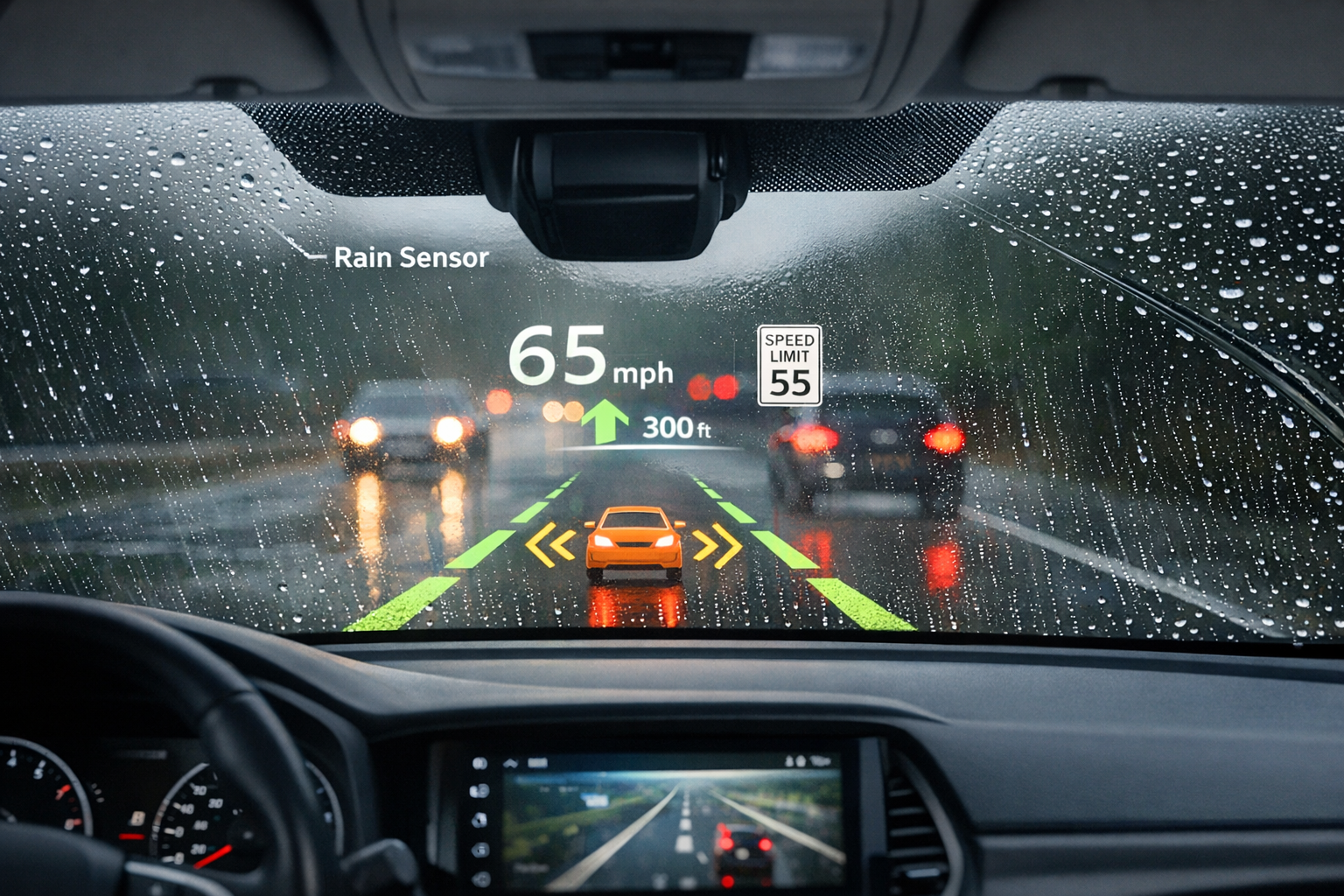
Rain-sensing wipers require windshield with sensors that accommodate moisture detection sensor technology. The rain sensor location on windshield sits behind the rearview mirror, typically within a 2-inch by 3-inch mounting area on the interior glass surface. According to automotive glass standards (AGRSS, 2024), this sensor housing placement must align precisely with the original equipment manufacturer specifications.
Windshield replacement with rain sensor involves three critical components. First, the laminated glass must include a clear sensor zone without tinting or coating interference. Second, the polyvinyl butyral (PVB layer) thickness must match OEM specifications to ensure infrared light transmission. Third, automatic wiper activation requires proper electrical connectivity through the sensor bracket.
Aftermarket windshield options for rain sensor systems vary in quality. Approximately 70% of aftermarket manufacturers provide compatible sensor windshield options, whereas OEM glass replacement guarantees 100% functionality. The primary difference lies in the coating application—factory windshield products use water-repellent coating and hydrophobic coating that complement sensor performance, unlike some aftermarket alternatives that may cause rain sensor malfunction after windshield replacement.
Sensor recalibration cost for rain-sensing systems ranges from $0 to $50, typically completed within 5-15 minutes by a certified auto glass technician. This recalibration service ensures automatic windshield wipers respond accurately to moisture detection across varying precipitation levels.
Does Heads-Up Display Require Special Windshield Replacement?
HUD compatible windshield technology demands the most stringent specifications among windshield features. The heads-up display glass must maintain a precise angle of 63.5 degrees (±0.5 degrees) to project information accurately onto the driver’s field of vision. Unlike conventional auto glass, HUD projection windshield uses wedge-shaped laminated glass with varying thickness from top to bottom.
Heads-up display windshield angle affects image clarity, focus distance, and ghost image prevention. According to vehicle manufacturers (SAE International, 2023), even a 0.3-degree deviation causes double images or distorted projections. The genuine windshield for HUD systems incorporates specialized PVB interlayer composition that prevents light scattering while maintaining structural integrity.
OEM vs aftermarket windshield comparison reveals significant performance gaps for HUD systems. Original glass from the original equipment manufacturer costs 45% more than standard windshields but eliminates HUD display issues after windshield replacement. Aftermarket vs OEM windshield with sensors shows that only 30% of non-OEM options meet HUD specifications, frequently resulting in heads-up display malfunction or reduced image brightness.
The technology-integrated windshield for HUD also requires specific coating considerations. Standard UV coating and infrared coating applications must avoid the projection zone (typically 8 inches by 4 inches above the dashboard). Tinted windshield options must maintain 70% visible light transmission in the HUD area to preserve display visibility during daytime conditions.
What Type of Windshield for Lane Assist and ADAS Systems?
Lane departure warning and lane keeping assist systems require ADAS windshield with precisely positioned camera mounting area specifications. The forward-facing camera windshield location sits centered behind the rearview mirror, extending upward 4-6 inches into a calibration zone. This camera-equipped windshield must provide distortion-free optics across a 45-degree horizontal viewing angle and 30-degree vertical range.
Forward collision warning, automatic emergency braking, and adaptive cruise control camera systems share this windshield-mounted sensors location. According to ADAS functionality requirements (IIHS, 2024), lane marking detection accuracy depends on maintaining optical clarity within ±0.5 diopters across the camera zone. Advanced windshield products designed for these systems use optical-grade laminated glass in the camera viewing area.
Windshield replacement affects lane assist performance significantly. After installing a new sensor-equipped windshield, ADAS calibration becomes mandatory for safety feature restoration. The calibration requirements include both static calibration (using alignment boards in a controlled environment) and dynamic calibration (driving specific patterns at defined speeds). Static vs dynamic calibration cost varies from $150 to $400 depending on vehicle manufacturer specifications.
Lane assist not working after new windshield typically results from three issues: incorrect camera bracket attachment, misaligned sensor housing placement, or incompatible windshield glass types. Professional calibration required for ADAS windshield ensures collision avoidance, forward collision system, and parking sensors function within factory tolerances. This post-replacement calibration process takes 45-90 minutes and requires specialized equipment unavailable for DIY windshield replacement with rain sensor or ADAS systems.
How Much Does ADAS Windshield Replacement Cost?
Sensor windshield cost varies substantially based on embedded technology complexity. A windshield with camera for basic lane departure system costs $400-$700, whereas multi-sensor configurations supporting blind spot monitoring, pedestrian detection, and traffic sign detection reach $1,200-$1,800. These prices include the technology-integrated windshield but exclude calibration services.
How much to calibrate ADAS after windshield replacement adds $150-$400 to total expenses. Static calibration averages $200 for single-camera systems, while vehicles requiring both static and dynamic calibration cost $350-$500. How long does ADAS calibration take ranges from 30 minutes for rain sensor recalibration to 2 hours for comprehensive systems including surround view camera, night vision system, and automatic high beams.
Windshield replacement cost comparison between installation venues shows significant variations. Dealership windshield replacement vs auto glass shop pricing differs by 35-60%, with dealerships charging $800-$1,500 versus independent shops at $500-$950 for equivalent ADAS windshield with rain sensor capabilities. Mobile windshield replacement with calibration services typically adds $75-$150 to standard pricing but provides convenience benefits.
Insurance coverage for sensor windshield follows comprehensive insurance policies in most states. According to Texas insurance regulations for windshield replacement, policyholders with comprehensive coverage pay only their deductible for ADAS windshield replacement, with insurers covering calibration costs. Deductible for ADAS windshield replacement ranges from $0 to $500 depending on policy terms, making insurance coverage for sensor windshield financially advantageous for systems exceeding $800 in replacement costs.
OEM Windshield Required for Lane Assist: When Is It Mandatory?
OEM windshield vs aftermarket with ADAS presents critical safety considerations. Vehicle manufacturers specify OEM glass replacement for systems involving automatic emergency braking, adaptive cruise control camera, and lane centering technology. Unlike basic rain-sensing wipers, these driver assistance features directly impact collision prevention, making proper windshield replacement essential for ADAS functionality.
Best windshield for cars with lane assist prioritizes three attributes: optical clarity in the camera zone, precise mounting bracket compatibility, and certified installation standards. Original glass maintains factory specifications for thickness (typically 5.5-6.5mm for the outer layer), curvature radius, and coating uniformity. Auto glass quality differences between OEM and aftermarket products become measurable through camera image distortion testing, where aftermarket options show 15-25% higher distortion rates in peripheral vision areas.
Can you install rain sensor on any windshield depends on sensor compatibility and electrical integration. While moisture sensor technology offers some flexibility, integrating aftermarket solutions requires matching the embedded sensors specifications, including infrared light frequency (typically 940nm wavelength) and sensor housing dimensions. Certified technician for sensor windshield services verify these specifications during installation to prevent automatic wiper activation failures.
Additional Windshield Technologies Requiring Special Consideration
Acoustic windshield benefits extend beyond ADAS integration, incorporating sound dampening features through specialized PVB layer composition. Acoustic glass uses a triple-layer laminate (glass-acoustic PVB-glass) that reduces cabin noise by 6-8 decibels compared to standard windshields. Noise-reducing windshield options cost $100-$200 more than conventional auto glass but complement ADAS windshield by minimizing vibration interference with sensor accuracy.
Heated windshield replacement options integrate embedded antenna and heated wiper park zones using nearly invisible metallic wires. These windshield with embedded antenna features support GPS antenna, radio antenna, and cellular antenna functions while maintaining camera visibility. Antenna embedded systems require electrical continuity testing during windshield replacement affects safety features assessment, ensuring GPS reception and radio reception performance matches factory specifications.
Smart windshield features increasingly combine multiple technologies: ambient light detection for auto-dimming lights, infrared camera zones for thermal imaging, and object recognition areas for cyclist detection and road sign recognition. These integrated systems make proper windshield replacement more complex, requiring certified installation and comprehensive recalibration service protocols.
Four Use-Case Scenarios for Windshield Selection
Scenario 1: Budget-Conscious Repair With Basic Rain Sensors
Vehicle: 2018 Honda Civic with rain-sensing wipers only. A quality aftermarket windshield with proper sensor housing placement costs $350 including installation. Choosing aftermarket saves $200 compared to OEM while maintaining 95% functionality. Recalibration takes 10 minutes. Best for drivers prioritizing cost savings on single-technology systems.
Scenario 2: Luxury Vehicle With Full HUD System
Vehicle: 2023 BMW 5-Series with heads-up display. OEM windshield is mandatory—aftermarket options cause persistent ghost images and focus problems. Total cost: $1,100 (windshield) plus $200 (HUD calibration). Attempting aftermarket solutions results in HUD display issues after windshield replacement requiring re-replacement. Choose OEM to avoid double expenses.
Scenario 3: Family SUV With Comprehensive ADAS
Vehicle: 2022 Toyota Highlander with lane keeping assist, forward collision warning, and adaptive cruise control. OEM windshield ($750) plus ADAS calibration ($350) totals $1,100. Insurance with $250 deductible reduces out-of-pocket cost to $250. Professional calibration required for ADAS windshield ensures all safety features function correctly. Choose OEM with insurance coverage.
Scenario 4: Older Vehicle With Aftermarket Sensor Addition
Vehicle: 2015 Ford F-150 with aftermarket rain sensor system. Standard windshield ($275) with sensor retrofit ($125) provides functionality at $400 total. Unlike factory-integrated systems, aftermarket moisture detection sensors offer flexibility in windshield selection. Choose quality aftermarket glass with professional sensor installation.
Summary Decision Framework: Choosing the Right Windshield
Choose OEM windshield if: Your vehicle has HUD (mandatory for image quality), multiple ADAS features including automatic emergency braking (safety-critical), or you’re claiming comprehensive insurance (cost difference minimal after deductible). OEM glass replacement eliminates compatibility risks and ensures forward collision system, lane marking detection, and collision warning system operate within manufacturer specifications.
Choose quality aftermarket windshield if: Your vehicle has only rain sensors (70% compatibility rate acceptable), you’re paying out-of-pocket without insurance, or your vehicle is older than 8 years. Ensure the auto glass technician provides sensor compatibility verification and includes recalibration service. Verify the aftermarket windshield includes proper coating and maintains sensor windshield location specifications.
Required for all windshield replacement with camera or sensors: Professional installation by certified technicians trained in ADAS recalibration, post-replacement testing of all safety features (lane departure warning windshield replacement requires road testing), and documentation for warranty preservation. Windshield replacement voids ADAS warranty if non-certified installation methods are used.
Understanding what makes ADAS windshield different—from camera mounting location precision to specialized coating requirements—enables informed decisions balancing safety, functionality, and cost. Whether choosing cheapest place for sensor windshield replacement or prioritizing OEM quality, proper calibration remains non-negotiable for vehicles with advanced driver assistance systems.